Monday, 24 April 2023

The Importance of Robert Owen and his links with Belper

Belper Town Council decided to support the plan to place a clock on the façade of the Co-op store in Strutt Street to celebrate the life of Robert Owen and his links with Belper. The idea was supposed to coincide with the 250th anniversary of Robert Owen's birth but in 2021 we were still experiencing the restrictions of the Covid pandemic. Manufacture and installation of the clock had to be postponed. The co-op movement has been commemorating the 250th anniversary of Owen’s birth, and his belief that society could be transformed peacefully and ordinary working people should be able to enjoy education, good health, decent living conditions and recreation.


 So who was Robert Owen?

Robert Owen
(William Henry Brooke)
National Portrait Gallery

Owen advocated a day split into eight hours work, eight hours recreation and eight hours rest – and the clock’s design is split into three segments representing the 24-hour period. He was instrumental in raising the age that children could be employed in mills to 10.

Born in 1771 in Wales Robert rose to be a mill owner and promoted his "utopian socialist" ideals. He went on to promote socialist communities which were a primary influence on the development of the cooperative movement and the creation of unions.

He became nationally important through his influence on the Cotton Mills and Factories Act 1819 which was an Act of the Parliament of the United Kingdom, which was its first attempt to regulate the hours and conditions of work of children in the cotton industry. It was introduced by Sir Robert Peel, who had first introduced a bill on the matter in 1815. The 1815 bill had been instigated by Robert Owen, but the Act as passed was much weaker than the 1815 bill; the Act forbade the employment of children under 9; children aged 9–16 years were limited to 12 hours' work per day and could not work at night. There was no effective means of its enforcement, but it established the precedent for Parliamentary intervention on conditions of employment which was followed by subsequent Factory Acts.

What is his link with Belper?


Owen was an associate of William Strutt – the son of Jedediah Strutt, a partner of manufacturer and inventor Richard Arkwright – and his progressive ideas influenced the way the Strutt family developed their mill empire in Belper, making provision for employees and their families. The choice of the Belper Co-op in Strutt Street is therefore a good choice for the clock and recognises the importance of the Strutt family in the social history of our nation.


Heritage is not just bricks and mortar

Mention "heritage" in Belper and immediately people think of the North and East Mills; there is though so much more, the heritage of ideas. The Strutt family were heavily influenced by the philosophy and ideas that flowed from the enlightenment and it was only natural that they would have welcomed the chance to discuss social reforms with Robert Owen. The mills will take tens of millions to adapt and preserve so is way out of reach of local councils although their active support will be needed if a sustainable funding source can be found. It is however possible to promote the importance of Belper and its place in the development of social reforms. Belper Town Council has voted to partner with the Central Co-op to commemorate Robert Owen's birth and we look forward to a nationally significant unveiling ceremony which will bring many visitors to our town.

Finally - a YouTube video exploring Robert Owen's life in more detail


Tuesday, 11 April 2023

Belper Town Council - Labour responded to increased flooding risks.

 I became aware of the changing flood risk in the Derwent Valley whilst working on the NP4B (Neighbourhood Plan for Belper link to AVBC Flood Risk Assessment) and it was apparent that Belper Town Council would have to develop a local response to that increased risk. The 100 year flood event was becoming likely every ten years whilst the ten year event was nigh on annual.

Following Labour taking control of the council in 2019 flooding was duly targeted as a prime task and this initiative was led by Councillor Emma Monkman. This is her brief outline of what has been done:

 Flooding work

Councillor Emma Monkman
When we were elected in May 2019 there was no flood policy or group, despite being a river town. In November 2019 Belper and Milford experienced a significant flood event and it was then that we realised how vulnerable we were in this area. I created the Belper Flood Watch Scheme, recruited and trained volunteer Flood Wardens, and created a flood response fund of £10,000 for the people of Belper and Milford.

I have been working with the Environment Agency, Derbyshire County Council and Communities Prepared to develop a Community Flood Plan for the Town. This is a live document and will constantly need updating which is why we need to be re-elected, no other Party can be trusted with this work.
The next step is to link in with other flood schemes and councils along the River Derwent. This will become the Lower Derwent Flood Forum and together we can ensure flooding makes it to the top of the agenda when the Local Resilience Forum meet and designate priorities.
In November 2019 7 residential properties were flooded, and several business properties including our Mill. Since then, we have had 2 other flood events and each time we are more prepared. With the latest flood event in early 2022 our efforts meant that 2 residential properties were flooded. We need to get that figure to 0 and we are the party to do that.


Now that is indeed a brief outline especially when compared with the welter of procedural documentation, notes of meetings and research that I am aware has been produced to make the Belper Town Council response to this threat. Then there is the hours of support given to local residents or standing on the flooded bridge by the North Mill weir to advise motorists of the best diversionary routing.

The River Derwent flooded its banks in Belper in October 2019. This photo taken as Labour councillors inspected the scale of the flood.

It's not just water

When the Derwent floods our valley it will be accompanied by a release of sewage across the land. In a Derbyshire Live article it is stated that the Derwent is the most polluted river in Derbyshire with 4,931 dumps (36,096 hours) in 2021. Further reading on the Top of the Poops website elicits that much of that discharge is upstream from Belper, Milford and Duffield ............ what gets dumped in Matlock can end up in houses, gardens and fields downstream. The solution to this problem is to re-nationalise the water industry and to bring back control of our environment to government. A town council can do very little in the big scheme of things but Belper Town Council has responded to the challenge and does make a difference.


The privatisation of our rivers 

In 1989  our water – something we all owned – was sold off. Privatisation has largely enriched private shareholders who have done little to invest in this essential public service.

When the water companies were sold off, the government took on their historic debts. Since, they have accumulated over £45bn of debt that is ultimately the responsibility of billpayers or governments.

We were told privatisation could do things more cheaply but water bills rose by 40 per cent in real terms, according to the National Audit Office.

We were promised that privatisation would unlock more investment but less was invested in 2018 than in 1990.

We were told that nationalised industries wasted money, but one water boss took home £2 million after venting 4.2 billion litres of sewage into rivers – over which his firm eventually paid £20 million in fines.

Over a decade, the nine large English companies have paid out as much in dividends as they have made in profits.

All for providing a service in a “market” in which they don’t compete for customers, when fines for non-compliance with drinking-water quality standards have exceeded £1.5 million over the last five years, and where we lose enough water for 20 million people to leaks every day.

It’s hardly surprising that support for public ownership of water, at 83 per cent, is higher than for any other utility. 

Labour has laid out plans for what that public ownership will look like; regional water authorities whose boards comprise local-government representatives, employee representatives and representatives of community, consumer and environmental bodies.

The real expertise sits with the workers who ensure our water arrives reliably and cleanly into our homes.

We want those real experts at the heart of making sure we have environmentally sustainable, safe and affordable water.

Thirty four years on from the Conservatives’ historic mistake we can’t wait for the chance to reverse it.

A report in the Independent in 1994


Monday, 10 April 2023

Community Transport and Belper Town Council

 Belper Town Council (BTC) has for many years been a supporter of Derbyshire Community Transport (DCT), a charity that, as it says on its website:

At Derbyshire Community Transport we believe that no one, regardless of age, ability/disability, financial status or domestic location should be prevented from enjoying a full life because of lack of access to transport.

To do this we run services aimed at getting people out and about. We are focussed and passionate about ensuring everyone has access to transport that suits their individual needs.

Our ambition is to be at the heart of the community we serve and to act as the means by which local people are able to participate fully in their local communities.

Link to Derbyshire Community Transport website

The Car Club

The Car Club Ford Torneo outside St.Peter's Church
When Labour councillors took control of Belper Town Council in 2019 we realised the potential of community transport for a town that was inundated with private
vehicles and gradually losing bus services. This trend had to be reversed. The pandemic threw a spanner in the works but emerging from lockdown opportunities to improve public transport started to emerge. We had been very concerned that the number of available wheelchair accessible taxis had halved in Amber Valley from 28 to 14 and wheelchair users were reporting problems in getting to hospital appointments or other venues. Because BTC had strengthened ties with DCT with one of our councillors joining DCT as a trustee board member we started a dialogue so that when the possibility of offering transport for people with disabling conditions came up we were fully supportive. What is now known as the Car Club, backed by a group of volunteer drivers and administered by DCT from their HQ in Marehay has just started. Two vehicles have been purchased, one, capable of taking full size powered wheelchairs whilst the other is an electric car modified with swivel front seats to aid getting in and out. Both are based on the Coppice car park and can be hired by the hour for £5, with or without a driver as long as you are registered as a member of the club (annual fee of £20).  A really cheap alternative method of transport. Belper Labour councillors see this as a first step and want to increase the number of volunteer drivers and build up a regular group of passengers and make this scheme a real success. Belper is one of only 4 towns in the country to offer a car club such as this. Details of the Car Club can be found here 

Bus route opportunities

The new 147 service in King Street
Derbyshire County Council has steadily withdrawn support for local bus services and this has brought transport poverty to many in our region. Covid lockdowns did not help matters as bus passengers were forced to stay at home and, with restrictions being lifted the numbers using public transport have been slow to return. Many commercial bus operators felt unable to continue on lightly used services and it is in these circumstances that Derbyshire Community Transport stepped in to keep the wheels turning. They took over the 143 and 147 routes; merging them to operated between Belper King Street, through Ambergate to Ripley Market Place. Labour Councillors entered into consultation with DCT and suggested that the 147 could be extended into Parks Estate. DCT tested the idea and now we have a tree times a day service, as described by DCT:

• Route 143 combines the old 143 and 147 routes creating additional links 
• Improved service between Ripley and Belper – 3 return journeys a day 
• New link between Street Lane, Marehay and Ripley to Belper and Babington Hospital 
• Three new round trips between Belper Town Centre and Parkside via Babington Hospital 
• Improved timetable from Street Lane, Marehay and Ripley to Sainsburys


Belper Labour councillors are already planning more services to provide a "town service" linking all estates to the Leisure Centre, Town Centre and other amenities, from Belper Lane End to Bargate, Laund Hill to Parks Estate ............. and to run in the evenings and all day Sunday.  You can only break free from private car use if you have fully comprehensive public transport alternatives. We look forward to exploring the opportunity to invest in a flexible, on demand electric town bus service fit for the 21st century.

Driverless electric bus as trialled in Inverness 


Wednesday, 29 March 2023

Car Parks in Belper

 There seems to be a lot of opinion being aired on social media regarding the issue of so-called "free parking" in Belper. It is important in such matters to distinguish facts from non-researched belief and this post attempts to provide that factual base. The main contentions are that businesses will be harmed and that poor people will be impacted adversely but first let's look at why charges are being introduced.

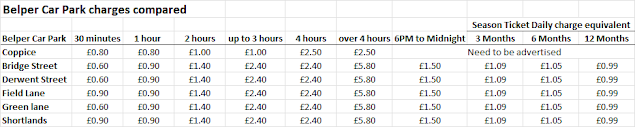
Coppice car park charges.

Referring to the Belper Town Council website provides us with a succinct account of their reason for introducing charges: https://www.belpertowncouncil.gov.uk/news/2023/03/coppice-car-park. We see that the cost in business rates is £22,500 per year (and I know that when these rates were applied by central government the charges were backdated to 2017. So not only does BTC have to pay the current years charge but make good the backdated amount which more than doubles the amount for, I think, three years (though business rates were suspended for one year during the Covid pandemic). The council states, "As a council, we believe it is fairer that users of the car park pay for their usage rather than this cost being supported by everyone in the town regardless of car ownership."

The suggested charges are shown below compared to other car park charges in the town:


You can find the AVBC car park information at: https://www.ambervalley.gov.uk/roads-and-parking/parking/

It should be noted that there is still more consultation required before charges are fixed and conditions applied. I can see that a change to the 4 hour charge on the Coppice may be anticipated because it stands out as the only increase over a charge in the other car parks. There has to be some clarity on the "over 4 hours" charge at the Coppice - does this mean 24 hours? If it does then that is superb value for those who park there and walk down to catch a train. Compare £2.50 with the charge of £14.50 at Derby Railway Station.

There will have to be some thought about season tickets and how they line up with AVBC offer but 99p a day that is hard to beat.

Finally, nearby residents will be offered parking permits as they currently depend upon the Coppice for longer term parking. This is a good step but which streets are referred to as "nearby" needs to be determined.


Will businesses and shops be harmed? 

There is a lot of misinformation being put online at the moment, some claims seeming incredible. I read that 97% of Belper residents were opposed to Coppice car park charges and that 86% of businesses were against it. I don't know anyone who has taken part in such a survey. When offered claims like this the Office for National Statistics advise that all evidence of such a survey should be disclosed. For example, 100% of the people I live with claimed that they were my wife. I think you get the picture.

As to businesses being polled; Belper Town Council invited local shops and businesses to take part in the initial round of consultation and only 2 responded. I can well understand that most shops are not too concerned as the sum total of car park spaces is well over a thousand (600 between AVBC & BTC plus all the supermarket car parks). The figure is probably much more as I have no hardened data for the spaces at Morrisons, Aldi and the Co-op. I estimate that the Coppice car park constitutes about a sixth of the total number of spaces available. If we factor in the AVBC residents permit and the number of folk who access the town via public transport or on foot/bicycle then the percentage impact of Coppice  car park charges on business is negligible. You have to keep a sense of proportion.

There are academic studies that look at the effect of withdrawing so-called free parking from town centres and I link to them here:

Leeds University - Parking Charges

Institute for Transport Studies

OECD - The Environmental effects of parking

These  three studies clearly show that charging for parking does not harm business activity and can offer clear commercial, environmental and health benefits. Below is one of a number of summary panels which are included in the Leeds University study (apologies for the quality of the image - I used screen snip)


Which brings us to:

Impoverished motorists

Sadly, the number of impoverished motorists has grown over the last few years as incomes have not kept up with the rising cost of living, exacerbated by a steep rise in inflation over the past few months. Let's look in more depth.

Pensioners in general have the time to shop and park using their AVBC residents permits and for a modest sum can do so after 14:00. They also have the use of a Gold Card and can travel on buses free after 09:30.

Household deprivation - Referring to the data now available from the 2021 Census we get a range of data to help us assess the number of motorists who may be impacted by proposed Coppice car park charges. For a start, 15% of households do not own a vehicle. Looking at the socio-economic data indicates, (if we assume levels 13 and below could be counted as impoverished) that there is a potential for 22% of people between the age of 16 and 64 could be impoverished. This does include 4.5% classified as students. I know that income data included in NP4B (Neighbourhood Plan for Belper) showed a potential for 14% of households to be below the poverty threshold (below 60% of current median (or typical) household income, taking into account the number of people living in the household. This does of course include all ages.

So how many motorists are impoverished? Sadly, many are but how many impoverished motorists use the Coppice car park ......... that we don't know. There are alternatives as I hope this article has shown however, some form of initiative to assist those dependent on cheap parking to gain an annual season ticket would be beneficial to ......... how many we don't know.


Source: https://www.ons.gov.uk/visualisations/customprofiles/build/

In conclusion

There are so many facts left out of this post. So much data from the 2021 Census or the Department of Works and Pensions area income data ................ or the Department for Transport annual traffic flow surveys  and for this you could look at  the NP4B on the Belper Town Council Website, specifically Addendum 5 Traffic survey and parking or Addendum 6 - Public Transport which does include data from the 2011 census showing that 33% of the 10th or lowest socio-economic households have the use of a single car.

You see, this is the sort of evidenced information that is needed if a true understanding is to be made of issues such as this. We live in the twenty first century and there should be no place for biased and deliberately misleading information to be spread on social media. 

Wednesday, 31 August 2022

EMR announce the resumption of peak hour through services, Matlock - Nottingham - Matlock from Monday 12th December 2022

 EMR have announced that peak hour through services, Matlock - Nottingham - Matlock will resume from Monday 12th December 2022. This announcement has been made by Will Rogers, Managing Director of East Midlands Railway.

He states:

"Services will operate in both directions during the morning and evening peaks, Monday to Friday – calling at all stations. As a result, we will also be reinstating hourly peak time services at Spondon and Attenborough. These services have been chosen as we believe they will provide the biggest benefit to customers while also being mindful of our levels of resource and the performance impact – particularly around Nottingham. Online journey planners are in the process of being updated and timetables will follow soon. In the meantime, I have included an outline timetable below. There may still be minor amends to the times below as a result of further validation so please continue to check before travelling.

Nottingham – Matlock 

Depart: 0653 Arrive: 0807 

Depart: 0753 Arrive: 0908 

Depart: 0854 Arrive: 1007 

Depart: 1554 Arrive: 1706 

Depart: 1654 Arrive: 1806 

Depart: 1754 Arrive: 1856 

Matlock - Nottingham 

Depart: 0617 Arrive: 0722 

Depart: 0712 Arrive: 0815 

Depart: 0813 Arrive: 0922 

Depart: 1515 Arrive: 1618 

Depart: 1615 Arrive: 1723

Our aspiration remains to introduce direct services between Matlock and Nottingham throughout the day and on Saturdays as well as further services on other parts of the EMR Regional network. However, that remains subject to the allocation of the necessary funding, maintaining levels of performance (punctuality) and the delivery of additional rolling stock. We will continue to provide updates as these workstreams progress in the months to come. I hope you will welcome this step forward and we look forward to the services resuming in December. 

 Kind regards, Will Rogers Managing Director East Midlands Railway"

Well done EMR for listening to passengers, particularly those who depend upon the service to get to work and college. We were promised a positive response at the meeting arranged by the Mayor of Belper with EMR management in March at the Strutt Centre. Special thanks to Laura Etheridge whose help made that meeting possible. We wanted a full restoration of service but all present accepted that peak hour trains should be a priority. 

Monday, 13 December 2021

Derbyshire Tories public transport plans - Less for More

 The woeful performance of Debyshire County Council (DCC) Tories in dealing with the cancelation of the 71 & 72 bus routes after Christmas has prompted a re-emergence of BelperStuff blog. This is yet another example of Tories claiming big investment into transport needs when the reality is cut after cut. The best way to illustrate this is to follow a timeline through the years of austerity. Yes this is the root cause of cuts to services, the year by year shrinking of the grant from central government to local authorities. The Tories took control in Westminster in 2010, at a time when the economy was starting to recover from the global credit crunch, with the promise that the country would have a balanced budget by May 2015. In the 2019 election the latest Tory prediction was that a balanced budget would be acheived by 2023 .... or would that be 2025.

2011 - More for Less ................. or .............. Less for More

Derbyshire County Council dutifully followed the party line and adopted policies reflecting the philosophy of austerity. This meant cuts to Derbyshire services but strategy papers tried to put a positive spin by claiming that efficiencies would be found to enable a bright shiny future under the Tories.

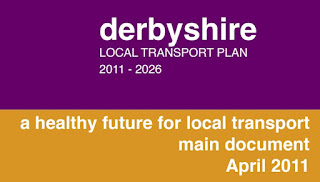
Derbyshire Local Transport Plan 2011 - 2026 


This plan was full of definitions of how decisions and policies would be determined but very short on key investment objectives. Mostly concerned with roads and potholes the only tangible policy initiative for public transport would be "Public transport (bus and rail) information"; found on page 4 of the document with nothing else of note in the following 121 pages. So the Tory promise for public transport over 15 years would be to improve information.

2017 - Tory County Council Election manifesto promise

"We will reverse Labour's cuts and restore important access to health and social care, shopping and social activities". 

Six years later and the cuts to services following the Tory Westminster government inspired austerity measures and the starvation of funds available to local authorities, meant that bus services would gradually lose county council support funding. The county had become Labour controlled in 2013 and in the run up to the 2017 election provided an analysis of the effect government funding cuts would have on Derbyshire services. The Tory manifesto response to this was to blame Labour for the cuts.

2018 - Derbyshire Tory cuts to bus services

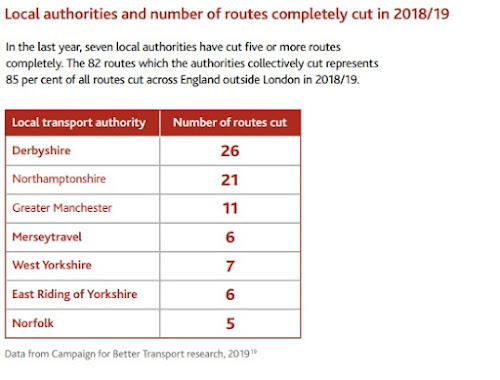
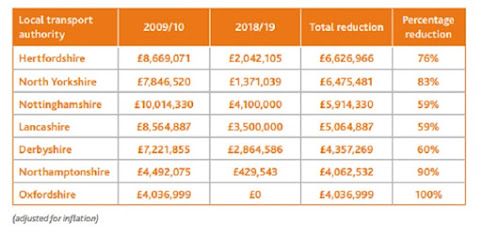
The Tories won back control of DCC in 2017 and by 2018 were making savage cuts to bus services. This is evidenced inThe future of the bus report , a paper produced by the Campaign for Better Transport in 2019. Below is an extract from that report:

The report clearly shows during 2018/19  Derbyshire Tories were complicit in cutting 26 bus routes; that's 27% of all routes in England outside London. Further to this the report indictes a reduction of 38% in the budget for Derbyshire School transport and that the overall budget for bus subsidy was cut by 60%.


2021 - Derbyshire Tory Manifesto

The only mention concerning buses in the Tory 2021 manifesto is that there would be free companion bus passes for disabled public transport pass holders. No mention of reversal of Tory cuts. The promise of 2017 just did not happen and in the 2021 election the failure to honour that pledge was conveniently forgotten.
-----------------------------------------

So now we turn to what was said by the Leader of DCC following the electoral victory in 2021. - delivery-pace-will-be-our-mantra-council-leader-cllr-barry-lewis-sets-out-aspirational-vision and here are listed key passages from the DCC AGM speech: 

"I am immensely proud of the achievements of the last four years

We know too that there is going to be significant change and hopefully investment coming for public transport, because something transformative needs to happen in this space to ensure we can meet our carbon reduction targets, not just locally but nationally.  As an administration we’ve already committed to working with the Peak District National Park Authority to trial and deliver innovative public transport solutions there. 

 our innovative Levelling up for Young People scheme, something I’m particularly keen on.  It is sadly the case that too many young people in Derbyshire, mainly young white males in our instance but also young white females to a lesser extent find themselves disconnected from education, educational opportunities and therefore from the world of work and possibly ending up getting involved in illegal or criminal behaviours eventually.

We’re also keen to get on with delivering our commitment for Companion Bus Passes for disabled public transport users, an important scheme that will make a big impact on the lives of some disabled people in Derbyshire.  It’s not just about the big things but about looking at where we can make a real difference to the lives of Derbyshire residents".

I will finish by saying we have a new mantra for the next four years “Delivery at Pace”  

-------------------------------

Welcome to the paralell universe inhabited by the entitled Derbyshire Tories. Barry Lewis is proud of being the leader of the county that cut more bus services than anywhere else in England. At least there is an acknowledgement that there has to be investment in public transport but 7 months later, when the resolve of Barry is tested by the unsustainability of the 71 & 72 bus routes, Derbyshire Tories can find no investment; their only concern being carbon reduction targets. Is this a hint of how that will be acheived .............. less buses equals less carbon in the atmosphere? Do they not realise that with every bus that is cut from service there will be an increase in the number of cars travelling on our roads?

Barry - if you are serious about carbon reduction then put your money into public transport.
(sorry, that should be our money raised from taxes)

Barry then goes on to comment on the "Levelling Up for Young People Scheme" which will address the disconnect with "education, educational opportunities and therefore with the world of work." The first priority for young people to access anything is to be able to get to where those opportunities exist. Cutting bus routes stops this sort of initiative dead in it's tracks. 

Barry does however point out that these nebulous Tory ambitions will be subject to "Delivery at Pace". What good is that catchphrase for those who become isolated and disenfranchised from normal opportunities of life, because their bus services have been cut. If they have no car then the alternative is to go by foot; for them it will be:

Delivery at Walking Pace

Sunday, 12 December 2021

Bus services lost in Belper - We expect better from our county council

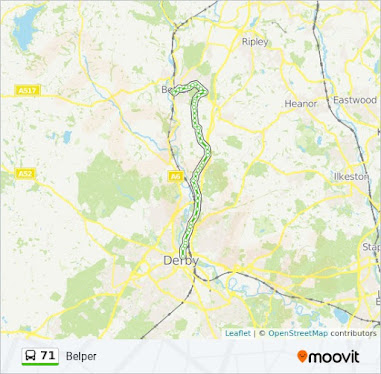
The recent announcement by Notts & Derby Bus company that they could not make the 71 and 72 routes between Belper and Derby pay or even recruit enough drivers came as a real shock for residents who depend upon these services to get to work, college or school; to shop or have an acceptable level of cultural or social life. Derby Telegraph December 1st article

Many in the community contacted Derbyshire County Council to urge them to step in and this they have done though the solution that has been agreed for the continuance of service past the threatened deadline of Christmas Eve is far from ideal. Ther Derby Telegraph reported the 7's being replaced from 29th December by an extension of the 137/8 Langley Mill <> Belper service which would allow passengers to access Derby via a connection with the 59/59A Derby <> Shipley service but in reality the best routing will be via  "the nines" at Kilburn Toll Bar. BelperStuff checked the Derbyshire County Council website news to check for accuracy but here too it states that a combination of 137/8 and 59/59A services will replace the 71/72 services when they are discontinued we must hope that more definitive information will emerge in the next few days.

Timetables/ 137& 138 Belper<>Langley

Timetables/ 59/59A

Timetables/ the nines Derby <> Ripley etc.

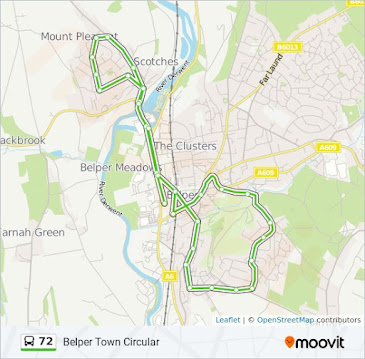
Aside from passengers from Holbrook, Bargate and Parks areas losing their direct link with Derby this effectively means that on a school day the first bus into Belper from the Parks will be at 09:49. The loss of the 72 service impacts badly on not just the Parks Estate etc but also Mount Pleasant.

There are still questions to be answered:

  • Where are passengers expected to change between the 138 and the 59 services?
  • When will an integrated timetable be available?
  • Will through ticketing be allowed if passengers combine the 138 and the more obvious 9 services?

Belper estates still lack services in the evenings or on a Sunday.

This is hopefully an interim situation

The routes being lost are:


 Credit to moovitapp for these maps

The loss of the 71 and 72 services has happened despite promises by Derbyshire Tories to protect public transport in the county. In 2011 they proudly announced "more for less" in their Derbyshire Local Transport Plan 2011 - 2026. Cancelation of bus routes is what they are actually delivering. BelperStuff will explore the Tory record on public transport in Derbyshire in the next blog post - Less for More.